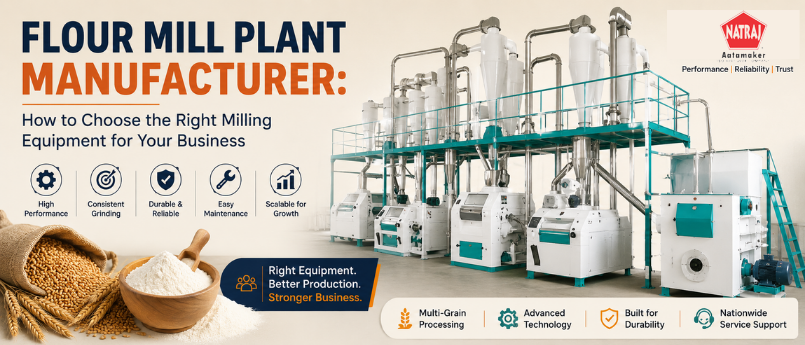
Flour Mill Plant Manufacturer: How to Choose the Right Milling Equipment for Your Business
Flour Mill Plant Manufacturers: Make a choice about the appropriate milling machinery according to the production capability, efficiency, flour quality, automation, and maintenance requirements. An efficient flour mill plant is important for increased productivity and business growth.
Choosing milling equipment isn't something a flour business should rush.
The machine may sit at the centre of the operation, but its real value shows up every day: how much grain it can process, how consistently it works, how easy it is to maintain and whether it can keep up when orders increase.
That is why selecting the right Flour Mill Plant Manufacturer requires more than comparing machine prices.
Start With Your Production Requirement
A small flour grinding business and a large commercial operation don't have the same requirements.
Before speaking with a manufacturer, work out a few basics:
- ✔️ Expected daily production
- ✔️ Types of grains to be processed
- ✔️ Available installation space
- ✔️ Electricity supply
- ✔️ Required flour fineness
- ✔️ Number of operating hours
- ✔️Labour available for operation
- ✔️ Future production plans
This gives the manufacturer something useful to work with.
Instead of asking, "Which flour mill should I buy?", you can ask, "I need to process this quantity of wheat and other grains every day. Which setup fits that requirement?"
That makes the discussion much more practical.
What Goes Into a Flour Mill Plant?
A Flour Mill Machine setup is not necessarily just one machine.
Depending on the scale and process, a plant may involve equipment for grain handling, cleaning, grinding, flour collection and other stages.
For businesses, the important thing is how these components work together.
A machine with impressive individual specifications may not be the right choice if it doesn't fit the rest of the production workflow.
Think about these areas:
Capacity: Can the equipment handle your expected workload?
Grain compatibility: Will you process only wheat, or also maize, rice, bajari, jowar, pulses and other grains?
Space: Does the proposed setup fit your premises comfortably?
Power: Is the electrical infrastructure suitable for the machinery?
Operation: How much manual intervention is required?
Maintenance: Can routine cleaning and servicing be handled without disrupting production?
Natraj Aata Chakki's product range covers both domestic and commercial flour milling requirements, while its commercial and heavy-duty equipment is positioned for businesses requiring regular grinding.
Capacity Is Not Just a Number
This is one area where buyers should read specifications carefully.
A manufacturer's stated grinding capacity can vary depending on the grain being processed and operating conditions. For example, Natraj's published specifications show different grinding capacities for wheat, rice, maize, bajari, rava, daliya and other materials.
So if you're planning a commercial flour business, don't ask only about the maximum capacity.
Ask about the capacity for the grains you actually intend to mill.
That number is much more useful for planning production.
A Quick Comparison Before You Decide
|
Requirement |
What to Evaluate |
|
Small business |
Compact commercial or heavy-duty machine |
|
Regular bulk grinding |
Higher-capacity commercial equipment |
|
Multiple grains |
Multi-grain processing capability |
|
Limited floor space |
Compact machine or suitable plant layout |
|
Long operating hours |
Motor, cooling and build quality |
|
Growing business |
Scalable equipment and service support |
The right equipment is the one that fits the operation rather than simply having the largest motor or highest headline capacity.
What Makes a Manufacturer Worth Considering?
A machine is a long-term business investment.
So look beyond the equipment itself.
A reliable manufacturer or supplier should be able to provide clear information about:
- 1. Machine specifications
- 2. Installation requirements
- 3. Operating instructions
- 4. Warranty terms
- 5. Spare parts
- 6. Maintenance
- 7. Technical assistance
- 8. After-sales service
Natraj Aata Chakki states that it provides service and maintenance support through locations across India and focuses on equipment designed for ease of use, durability and safety.
That kind of support can become particularly important once the machine is part of a daily production routine.
Why Natraj Aata Chakki?
Natraj Aata Chakki, operated by Flora Appliances Pvt. Ltd., has experience across domestic and commercial kitchen equipment and says it began its journey with Natraj domestic flour mills before expanding its range. The company currently offers flour mills alongside other commercial food-processing equipment.
For someone comparing a Atta Chakki Plant Manufacturer, this broader experience can be useful when the requirement involves more than a basic grinding machine.
The manufacturer should understand the practical side of the business: production, operation, maintenance and service.
Before Placing Your Order
Keep this checklist handy:
- ✔️ Define your daily production target
- ✔️ List the grains you want to process
- ✔️ Check available floor space
- ✔️ Confirm electrical requirements
- ✔️ Compare actual grain-wise capacity
- ✔️ Understand maintenance needs
- ✔️ Ask about installation
- ✔️ Check warranty and service coverage
- ✔️ Confirm spare parts availability
- ✔️ Discuss future expansion if your business is expected to grow
A flour mill plant should make production easier, not create another operational problem.
If you're setting up a new milling business or upgrading an existing one, compare the equipment against your actual production needs, grain types and available infrastructure before making the investment. Explore Natraj Aata Chakki's milling solutions at www.natrajaatachakki.com.