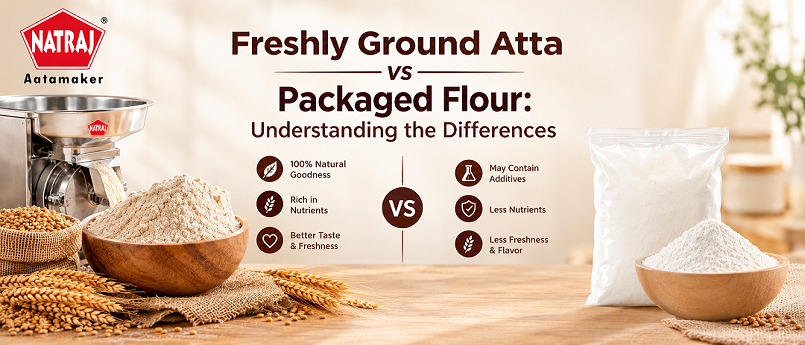
Freshly Ground Atta vs Packaged Flour: Understanding the Differences
Freshly ground atta offers greater control over wheat selection, grinding time, quantity, and texture, while packaged flour provides convenience and ready-to-use preparation. Both require proper storage, and the right choice depends on household needs, cooking habits, preferences, and flour consumption.
Flour is a staple ingredient in most Indian kitchens especially for the preparation of roti, chapati, paratha and other traditional dishes. Packaged flour is convenient and easily available but many households like to grind wheat at home for fresh atta.
This raises a common question: What is the difference between freshly ground atta and packaged flour?
The answer is not simply about which one is better. Both options have their own advantages depending on how you shop, store, prepare and use flour.
Freshly ground atta gives households more control over the wheat they use and when it is milled, while packaged flour offers convenience, consistent packaging and easy availability.
Let's understand the differences in more detail.
What Is Freshly Ground Atta?
Freshly ground atta is flour produced by grinding whole wheat shortly before it is used.
With a home atta chakki, wheat grains can be cleaned, checked and ground according to the household's requirements. The flour can then be used immediately or stored for later use.
The grinding process can also be adjusted depending on the type of flour and texture preferred by the family.
What Is Packaged Flour?
Packaged flour is commercially produced, processed and packed before reaching consumers.
It is generally manufactured in larger quantities and distributed through retail stores, supermarkets and online channels.
Packaged atta is convenient because consumers do not need to purchase a flour mill or grind wheat themselves. They can simply open the package and use the flour as required.
Freshly Ground Atta vs Packaged Flour: Key Differences
The main differences can be understood by looking at freshness, control, convenience, storage and preparation.
|
Factor |
Freshly Ground Atta |
Packaged Flour |
|
Grinding |
Ground shortly before use |
Ground before packaging |
|
Wheat selection |
User can select the wheat |
Flour comes from the manufacturer's selected ingredients |
|
Quantity |
Can grind according to requirement |
Usually purchased in predetermined quantities |
|
Convenience |
Requires grinding |
Ready to use |
|
Storage |
Can grind smaller quantities more frequently |
Requires proper storage after opening |
|
Texture |
Can be adjusted depending on the machine/settings |
Generally follows the manufacturer's processing |
|
Process control |
More control at household level |
Processing is handled commercially |
1. Freshness and Grinding Time
One of the main differences is the time between grinding and use.
When wheat is ground at home, the flour can be prepared shortly before making dough. This means households can choose when to grind their wheat rather than purchasing flour that has already gone through processing, packing and distribution.
Packaged flour, on the other hand, is produced in advance and passes through the supply chain before reaching the consumer.
However, the actual freshness of packaged flour depends on factors such as production date, packaging, storage conditions and how long it has been kept after opening.
2. Control Over the Wheat
With home grinding, consumers can choose the wheat grains they want to use.
For example, a household can select wheat based on:
- ✓ Grain quality
- ✓ Source
- ✓ Variety
- ✓ Quantity required
- ✓ Personal preference
The selected wheat can then be ground at home.
With packaged flour, the consumer generally purchases the flour as prepared and packed by the manufacturer.
This makes home grinding particularly useful for people who prefer greater control over the basic ingredient used to prepare their atta.
3. Quantity and Grinding According to Requirement
A home flour mill allows users to grind wheat according to their immediate requirements.
For example, instead of grinding a large quantity at once, a household can prepare a smaller quantity when needed.
This can be convenient for families that prefer regularly grinding fresh flour.
Packaged flour is generally purchased in fixed pack sizes, so households need to decide how much flour they are likely to use before purchasing.
4. Convenience
This is where packaged flour has a clear practical advantage.
Packaged flour is ready to use. There is no need to:
- ✓ Select wheat
- ✓ Load the wheat into a flour mill
- ✓ Grind it
- ✓ Collect the flour
- ✓ Clean the machine
For busy households, this convenience can make packaged flour an easy option.
A home atta chakki requires an additional step, but modern automatic flour mills are designed to make the grinding process simpler for regular household use.
5. Control Over Flour Texture
Different people have different preferences regarding flour texture.
Some prefer finely ground atta, while others may prefer a slightly different consistency depending on the type of food being prepared.
With a suitable home flour mill, users can have greater control over the grinding process and can choose a machine according to their preferred flour texture.
Packaged flour generally comes with the consistency established during commercial processing.
6. Storage Requirements
Both freshly ground and packaged flour require proper storage.
Freshly ground atta should be stored in a clean, dry and airtight container if it is not being used immediately.
Similarly, once packaged flour is opened, it should be kept properly sealed and protected from moisture, heat, insects and contamination.
The storage environment can affect flour quality regardless of whether the flour was ground at home or purchased from a store.
7. Ingredient Awareness
Another consideration is knowing exactly what you are grinding.
When purchasing whole wheat and grinding it at home, the household starts with the grain itself.
This can be useful for people who want to know more about the raw material used for their flour.
Packaged flour, meanwhile, comes with product information on the packaging, allowing consumers to check details such as ingredients, nutritional information, manufacturer information and other product-specific details.
Reading the product label is always useful when selecting packaged food products.
8. Convenience for Different Family Sizes
The right option can also depend on household size.
Small Families
A small family may prefer grinding smaller quantities at regular intervals using a domestic atta chakki.
Medium-Sized Families
Families with higher daily flour consumption may benefit from a machine that offers an appropriate grinding capacity.
Large Families
For larger households, grinding capacity and operating convenience become more important when selecting a flour mill.
The important point is to choose a machine according to actual household usage rather than simply selecting the machine with the highest capacity.
Can Freshly Ground Atta Be Stored?
Yes, freshly ground atta can be stored, but storage conditions matter.
For better storage:
- ✓ Use a clean, dry and airtight container.
- ✓ Keep the flour away from moisture.
- ✓ Avoid prolonged exposure to heat.
- ✓ Store it in a suitable location.
- ✓ Use clean and dry utensils when handling the flour.
- ✓ Follow appropriate food-storage practices.
If a household prefers freshly ground flour, grinding smaller quantities more frequently can also be a practical approach.
What Can You Grind in a Home Atta Chakki?
The exact ingredients that can be processed depend on the specific flour mill model and its manufacturer's recommendations.
Depending on the machine, home flour mills may be designed for grinding ingredients such as:
- ✓ Wheat
- ✓ Rice
- ✓ Maize
- ✓ Bajra
- ✓ Jowar
- ✓ Other grains or cereals
Always check the product specifications and operating instructions before grinding anything other than the recommended ingredients.
Is Freshly Ground Atta Always Better?
There is no single answer that applies to every household.
Freshly ground atta provides advantages such as control over wheat selection, grinding quantity and timing.
Packaged flour provides convenience, availability and ready-to-use preparation.
The better choice depends on individual preferences, cooking habits, storage practices and how much control a household wants over the flour-grinding process.
The important factor is to select good-quality ingredients and store flour properly.
Why Are Home Atta Chakkis Becoming a Practical Option?
Modern home flour mills have made it easier for households to grind wheat without relying entirely on traditional manual grinding methods.
Features can vary between models, but domestic atta chakkis may offer:
- ✓ Automatic operation
- ✓ Different grinding capacities
- ✓ Easy-to-use controls
- ✓ Flour collection systems
- ✓ Safety features
- ✓ Compact designs
- ✓ Easy cleaning features
For households that regularly consume wheat flour, having a flour mill at home can provide greater flexibility over when and how much wheat is ground.
How to Choose a Home Atta Chakki
If you are considering a home flour mill, look beyond the appearance of the machine.
Consider:
Grinding Capacity
Choose a capacity suitable for your family's regular flour consumption.
Motor and Performance
Check the motor specifications and operating performance according to the manufacturer's information.
Cleaning System
A convenient cleaning system can make regular use easier.
Flour Texture
Check whether the machine provides the type of grinding consistency you prefer.
Safety Features
Look for appropriate safety mechanisms and follow the manufacturer's operating instructions.
Maintenance
Consider how easy the machine is to clean and maintain.
Warranty and Support
Check the warranty terms and after-sales support available with the product.
Freshly Ground Atta and Natraj Aata Chakki
For households that prefer grinding wheat at home, Natraj Aata Chakki offers domestic flour mill options designed for regular household use.
Different models can have different specifications, capacities and features, so the appropriate machine should be selected according to the family's actual requirements.
Rather than choosing a flour mill based only on appearance or maximum capacity, consider your daily usage, preferred features, available space and maintenance requirements.
Conclusion
The difference between freshly ground atta and packaged flour mainly comes down to how the flour is processed, stored and used.
Freshly grinding wheat at home can provide greater control over the wheat selection, grinding quantity and timing. Packaged flour, meanwhile, offers convenience and is readily available for everyday cooking.
For households interested in grinding wheat at home, a suitable atta chakki can make the process more practical and convenient.
Ultimately, the right choice depends on your family's flour consumption, cooking habits, storage preferences and the level of control you want over the grinding process.
FAQ's
Is freshly ground atta different from packaged flour?
Yes. Freshly ground atta is produced shortly before use by grinding wheat at home, while packaged flour is commercially processed and packed before reaching consumers.
Can freshly ground atta be stored?
Yes. It can be stored in a clean, dry and airtight container. Proper storage helps protect the flour from moisture and contamination.
Is packaged flour more convenient than freshly ground atta?
Generally, yes. Packaged flour is ready to use, while freshly ground atta requires wheat to be ground before use.
Can I grind different grains in an atta chakki?
This depends on the specific flour mill model. Always check the manufacturer's specifications and instructions before grinding different grains.
How often should I grind wheat at home?
There is no fixed schedule. It depends on household consumption, storage preferences and the quantity of flour required. Some families may prefer grinding smaller quantities more frequently.
What should I check before buying an atta chakki?
Consider grinding capacity, motor specifications, cleaning system, safety features, flour texture, maintenance requirements, warranty and after-sales support.